s and ʃ: one is bright, one is dark Mandarin has two sibilants that sit on either side of English /ʃ/: pinyin x (ɕ) is further forward and brighter, sh (ʂ) is further back and retroflex. So replacing /ʃ/ with either one is slightly off — x comes out close to /s/, sh drags in a retroflex colour. This page splits the difference into two things you can measure: brightness and length.
Six pairs: same vowel, only the opening sibilant changes
Each pair differs in one sound and both sides are read by the same speaker. Left is /s/, right is /ʃ/ — the highlighted symbol is the one measured.
Why the above-6 kHz share is shown as well: the centroid is easier to read but it gets pulled around by the following vowel — the same /s/ measures 8466 Hz in sun and 5293 Hz in sock. That makes shun at 5887 Hz higher than sock at 5293, so sorting on the centroid alone produces one crossing. The share above 6 kHz has no such problem: the lowest /s/ is 49%, the highest /ʃ/ is 44%, and the six pairs do not overlap at all.
So: use the centroid for direction, the share for the dividing line. Both are given because either one alone misleads — the only place on this page that needs two numbers.
Two cues, and this time they point the same way
On the previous page (final voicing) the cue varied word by word and could only be reported pair by pair. Not here.
Duration: ʃ is reliably longer, six out of six
Each pair is read by one speaker, and what is measured is the duration of the target sibilant itself. Across all six pairs /ʃ/ is longer: /s/ runs 40–60 ms, /ʃ/ runs 70–91 ms, the widest pair by a factor of two.
Duration is easy to measure but it is not the main cue — a difference under 2× is often heard as a change of tempo rather than a change of sound.
Brightness: the cue that actually separates them
/s/ is a sibilant with its energy concentrated above 5 kHz; /ʃ/ has a constriction further back and a longer front cavity, which cuts a large hole in the high frequencies.
Two numbers are given: the centroid (energy-weighted mean frequency) and the share above 6 kHz. The second is cleaner: the lowest /s/ is 49%, the highest /ʃ/ is 44% — no pair overlaps.
Both point the same way, so this page can draw a conclusion
In all six pairs /ʃ/ is longer and darker, without exception. That is what separates this page from final voicing: there the cue moved from word to word and each pair had to stand on its own; here the two cues agree and the page can simply say "go darker, go longer".
How much darker still varies per word, so the table reports each pair and refuses an average.
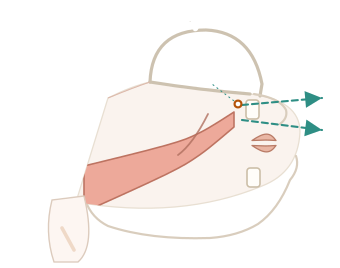
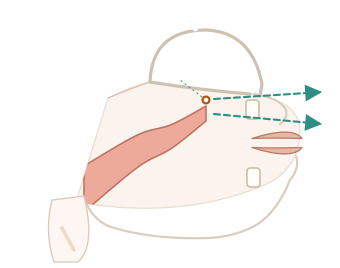
Articulation (side view)
One speaker, one instant: tongue position and lip shape only. The amber circle marks what to look at; the caption says how it differs from the sound it is usually confused with.
Spelling: /s/ has rules, /ʃ/ has a word list
You can mostly derive /s/ from the spelling. /ʃ/ has five or six spellings and no rule that covers them.
s occurs word-initially, medially and finally. It is usually /s/, but between two vowels it is often /z/ (is, rose) — that belongs to the z / ʒ page.
Doubled ss is reliably /s/, and it marks the vowel before it as short.
c is /s/ before e, i or y and /k/ everywhere else. The rule has almost no exceptions (the football club Celtic is one of the few).
The reliable one. sh is /ʃ/.
-tion is almost always /ʃən/; ci before a vowel is /ʃ/ (special); si before a vowel is /ʃ/ or /ʒ/ — vision is /ʒ/, which is the next page.
Native English ch is /tʃ/; French loanwords read it /ʃ/. There is no rule — it is a word list.
The four ways Mandarin speakers most often get it wrong
They share one root: Mandarin has two sibilants, one on each side of English /ʃ/.
Substituting pinyin x
Mandarin x is a palatal, constricted at the front of the hard palate — further forward than English /ʃ/, therefore brighter and close to /s/ to a listener. Read ship with x and it can be heard as sip.
This also explains a common experience: the sound is there, just placed too far forward, so the speaker thinks it is right and the listener does not.
Substituting pinyin sh
Mandarin sh is retroflex — the tongue tip curls up. English /ʃ/ is not retroflex: the blade lifts toward the hard palate with the tip flat. Using sh gets the darkness right and adds a retroflex colour that does not belong.
Using s for both
The direct one, and the reason these six pairs exist. The difference is not "hold it longer" but the friction energy itself: above 6 kHz the /s/ side is more than three times the /ʃ/ side.
Overcorrecting: turning every s into ʃ
Some learners, having acquired /ʃ/, shift every s backwards. These six pairs run in both directions — sip and ship, sue and shoe are both in the table — and both directions have to come apart.
Word list
27 words grouped by where the sound sits in the word. Click a word to hear it. These are recorded as separate words, not cut out of the sentences above — a word cut from a sentence carries its neighbours' transitions and always sounds muddier. All three groups use the same speaker, so what changes between them is position, not voice.
Word-initial9
Word-medial9
Word-final9
Corpus and acoustic measurements
Click any word in a sentence to play from that word. The pale band over the waveform marks the measured boundary of the target word.
Per-token data
Every number below is measured directly from the audio, not hand-annotated.
| Token | Accent | Sex | Target | Word length | sibilant duration | F0 | Pitch range | HNR |
|---|
Where the numbers come from
Every figure on this page can be recomputed from the notes below.
Corpus: 12 English sentences generated by a speech synthesis engine. Each minimal pair is read by one speaker — the difference is the teaching point here, and switching speakers would fold voice quality into it.
Word boundaries: taken from the engine's word-level WordBoundary events, with the constant offset between the engine timeline and the audio onset corrected per item.
Phoneme boundaries: forced alignment with the MMS_FA acoustic model, mapping character-level timestamps onto the phoneme sequence by dynamic programming; the model's frame is 20 ms and each boundary falls on a midpoint between character spans, so the effective resolution is about 10 ms.
Sibilant spectrum: computed only on the fricative interval the alignment reports, not by hunting for the noisiest stretch of the sentence — sentences often contain a second sibilant (ship is followed by sea), and hunting picks up the wrong one while the result merely looks like "they do not separate". The interval is Hann-windowed and transformed: centroid = Σ(frequency × magnitude) / Σ magnitude, above-6k share = energy above 6 kHz over total energy. The sampling rate is the original 24 kHz; resampling to 16 kHz would remove everything above 8 kHz, lowering the centroid and compressing the gap. Intervals shorter than 20 ms are not measured — the frequency resolution is too coarse and the number would be set by the window length.
What this page is: a view of how these sounds are distributed in the given corpus, not a pronunciation standard. Do not memorise the absolute values — the same /s/ moves by 3000 Hz between words. What matters is which side is higher within a pair.
Transcription: this page uses an American style; no length marks are involved for these two sounds.