z and ʒ: two voiced sounds, one hidden in spelling
Mandarin has nothing that equals /ʒ/. Pinyin r is a retroflex voiced fricative (ʐ) — further back and curled; pinyin z is an affricate (ts), with no sustained voiced friction at all. So both /z/ and /ʒ/ have to be learnt, not substituted.
The other half of this page is spelling: /ʒ/ is almost never written z. It hides in the s of measure, the ge of beige, the si of vision.
Six pairs: three true minimal pairs, three just shared position
/ʒ/ almost never occurs word-initially in English, so six strict minimal pairs cannot be found. The first three differ only in that one sound (bays/beige, ruse/rouge, composer/composure). The last three only share a vowel and a position: easy/leisure, peasant/measure, zero/genre.
Saying so is more useful than forcing six.
Note that the “N ms longer” in each row header says that word's target sound outlasts its partner by N ms — it does not claim /ʒ/ is always longer. On this page that direction is genuinely mixed, and that is the evidence, not a defect.
Why both numbers: the centroid is more intuitive but gets pulled by the following vowel — the same /z/ reads 7889 Hz in zero and 4334 Hz in bays. Do not memorise absolutes.
This time duration does not help
The s / ʃ page had all six pairs going the same way — longer and darker. Here only the second half holds.
Duration: three of six pairs differ by under 1 ms
The /ʒ/ minus /z/ duration difference runs −20, +1, −11, 0, +10, 0 ms across the six pairs, in that order.
Pairs 2, 4 and 6 come out at 1, 0 and 0 ms — that is not a small difference, it is no measurable difference at all (resolution is about 10 ms). The other three differ by 20, 11 and 10 ms, but not in the same direction: in the first two /ʒ/ is longer, in the third /z/ is.
So this page does not use duration as a clue. The reason is voicing: /s/ and /ʃ/ are voiceless, and the length of a voiceless friction segment is set mainly by the articulatory gesture. /z/ and /ʒ/ carry vocal fold vibration, so the frication merges into the following vowel, the boundary is intrinsically fuzzy, and the measured length follows word shape and speaking rate.
Brightness: still separates, by a narrower margin
Within one speaker and one pair, /z/ beats /ʒ/ on the share of energy above 6 kHz in all six pairs.
But the absolute values sit a notch lower than on the previous page. The top of the range barely moves (/z/ 86.5% against /s/ 86.8%); what drops is the bottom — the lowest /s/ is 49.4%, the lowest /z/ just 31.9%. /ʃ/ spans 14–44%, /ʒ/ spans 11–44%.
The low-frequency periodic energy that comes with voicing pulls the distribution downward. That is what voiced sounds do, not a measurement error.
⇒ Numbers here cannot be compared directly with the s / ʃ page.
So this page can only compare within a speaker
Across speakers the ranges overlap: the lowest /z/ share here is 32% (Guy, bays), the highest /ʒ/ share is 44% (Aria, genre). Two different people can land on the same number.
Within a pair it is 6 for 6 — the difference is real, just too narrow to survive a change of speaker.
That is exactly where it parts company with the previous page: s / ʃ did not overlap across speakers at all, so it could support a sentence like “move darker”; z / ʒ can only support “same speaker, swap z for ʒ, direction holds”.
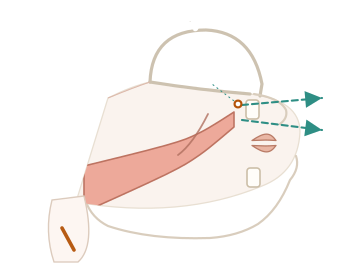
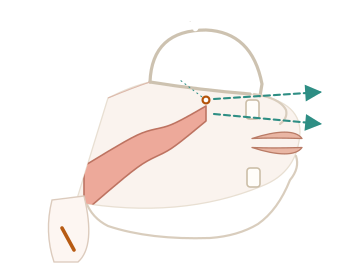
Articulation (side view)
One speaker, one instant: tongue position and lip shape only. The amber circle marks what to look at; the caption says how it differs from the sound it is usually confused with.
Spelling: z is easy, ʒ lives entirely in loanwords
/ʒ/ almost never starts an English word, and its spellings are three or four patterns, all tied to French loanwords.
z is /z/ wherever it appears. Doubled zz likewise.
An s between two vowels is usually /z/. This is the least intuitive line on the page — read from the spelling alone you would say /s/.
Word-initial x is /z/; elsewhere it is /ks/. Very few words.
-sion and -sure after a vowel are often /ʒ/. The identically spelled -tion is /ʃ/ — the difference is voicing.
Final -ge is /ʒ/ in French loanwords and /dʒ/ in native words (bridge, age). No rule — word list.
Four things Mandarin speakers get wrong
Two come from not having the sound, two come from spelling.
Using pinyin r for ʒ
Pinyin r is a retroflex voiced fricative: the tip curls up and the constriction sits behind the alveolar ridge. English /ʒ/ is not retroflex — the blade lifts toward the hard palate and the tip stays flat.
The result is not one wrong phone but a colouring that spreads across the whole word.
Reading it as dʒ from the spelling
This error is produced by English's own rules: ge and gi really are /dʒ/ in age and giant; only in a set of French loans do they become /ʒ/.
So half the difficulty of /ʒ/ is a vocabulary problem, not an articulation problem. Words like measure, pleasure, treasure, leisure, vision, beige, garage, genre have to be learnt one by one.
Reading z as pinyin z
Pinyin z is an affricate (ts): a closure, then a burst. English /z/ is a plain voiced fricative — airflow is turbulent from start to finish, with no burst.
Speakers often insert that burst word-initially, so zoo comes out as “dzoo”.
Devoicing every final -s
Plural, third-person and possessive -s is /z/ after a voiced sound and /s/ after a voiceless one. Mandarin has no voiced consonant codas, so the final /z/ is often simply devoiced.
Strictly this is not a /ʒ/ problem, but it belongs to the same family: English voiced fricatives stay voiced at the end of a word.
Word list
27 words grouped by where the sound sits in the word. Click a word to hear it. These are recorded as separate words, not cut out of the sentences above — a word cut from a sentence carries its neighbours' transitions and always sounds muddier. All three groups use the same speaker, so what changes between them is position, not voice.
Word-initial9
Word-medial9
Word-final9
Only one ʒ at the start of a word (genre): /ʒ/ almost always sits in the middle or at the end, and word-initial ʒ comes from French loanwords. Nothing is missing here — that is simply where the sound lives.
Corpus and acoustic measurements
Click any word in a sentence to play from that word. The pale band over the waveform marks the measured boundary of the target word.
Per-token data
Every number below is measured directly from the audio, not hand-annotated.
| Token | Accent | Sex | Target | Word length | Fricative length | F0 | Pitch range | HNR |
|---|
How the numbers were produced
This section describes how each value was computed, so it can be reproduced.
Corpus: 12 English sentences generated by a speech synthesiser. Every pair is read by the same speaker — the difference between the two words is the teaching point, and changing speaker would mix timbre into it.
Word boundaries: taken from the synthesiser's word-level timestamps (WordBoundary), with the fixed offset between the engine timeline and the audio start corrected per item.
Phoneme boundaries: forced alignment with the MMS_FA acoustic model, mapping character-level timestamps onto a phoneme sequence by dynamic programming. Time resolution is the model frame length of 20 ms (boundaries fall at the midpoint between character boundaries, about 10 ms effective).
Fricative spectrum: computed only on the segment returned by the alignment, with a Hann window and an FFT, then reduced to the energy-weighted mean frequency (centroid) and the share of energy above 6 kHz.
A number of better-looking words were rejected during corpus selection: in seizure, prestige and exposure the /ʒ/ is preceded by /s/, so a routine that takes “the first fricative in the word” would measure that s instead. None of the six targets here has another fricative before the target.
Scope: this page shows how these sounds were distributed in this corpus, not a pronunciation standard. Do not memorise the absolutes, and do not compare across speakers — here the lowest /z/ share (32%) and the highest /ʒ/ share (44%) overlap. What matters is which of the two is higher inside a single pair.
Transcription: American, with no length mark on long vowels (rouge is written /ɹuʒ/ here, where teaching materials usually write /ruːʒ/).