Voiceless dental fricative · th /θ/ is voiceless: tongue tip between the teeth, air squeezed through the gap, vocal folds still. It sits in roughly 0.1% of the world's languages — which is why so few learners arrive with it and most substitute something from their own inventory.
Three steps to /θ/
Get the place right and keep the folds still, and you have ninety percent of it.
Bring the tongue tip out
Rest the tip lightly between the upper and lower front teeth, or right behind the upper teeth. Do not press it against the ridge — that is where /t/ and /s/ live.
Let air through, not voice
Air keeps escaping through the narrow channel between tip and tooth edge. The vocal folds never vibrate; the throat stays relaxed. Put a hand on your larynx — you should feel nothing.
Keep the airflow continuous
It is a fricative, not a stop, so the air must not be cut off. Break the stream and you get tink instead of think, or tree instead of three.
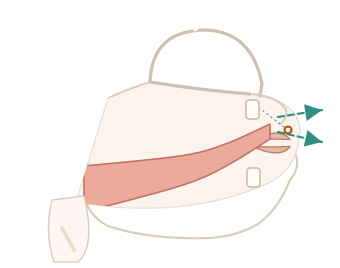
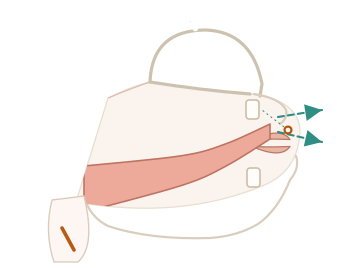
Articulation (side view)
One speaker, one instant: tongue position and lip shape only. The amber circle marks what to look at; the caption says how it differs from the sound it is usually confused with.
Spelling: one digraph, two sounds
English spells /θ/ and /ð/ almost only with th. The letters are easy; deciding whether a given th is voiceless or voiced is not.
Word-initial, medial or final. Every word in this row is voiceless /θ/.
Pronouns, articles, conjunctions, prepositions and adverbs spelled with th are almost all voiced /ð/. There are only a few dozen of them, but they are the most frequent words in the language — so in connected speech /ð/ outnumbers /θ/ by a wide margin.
Same letters, different sound. The noun or adjective takes /θ/, the verb takes /ð/: bath /bɑːθ/ → bathe /beɪð/, breath /breθ/ → breathe /briːð/. This is the one place where spelling alone cannot tell you the answer — you need to know what kind of word it is.
A handful of names and loanwords read th as /t/. Rare, but they are common names, so getting them wrong is conspicuous.
Why /θ/ is so hard to acquire
/θ/ is rare. Most learners' first language has no dental fricative at all, so the brain reaches for the nearest available sound — and every substitute is measurably different.
Substituting /s/
The alveolar /s/ is articulated a few millimetres further back. The only real difference is whether the tongue tip comes out past the teeth. Because both are voiceless fricatives, the ear accepts the substitute readily.
This is the single most common substitution worldwide — not a Chinese-specific error.
Substituting /t/
Turning a fricative into a stop: the tip closes fully, then releases. /θ/ never closes; /t/ has a complete closure phase.
Measurably, /t/ carries a silent closure gap that /θ/ does not. The three / tree pair is the classic minimal pair for this.
Substituting /f/
Labiodental instead of dental: the lower lip meets the upper teeth. Mandarin, Cantonese, Japanese and many other inventories have /f/ but no /θ/, so it is the nearest friction the learner owns.
The distinction is visible from the side — tongue for /θ/, lower lip for /f/.
Dropping or voicing it word-finally
Many languages do not allow consonant codas, so final /θ/ simply disappears. Voicing it produces /ð/, which in English can change the word: breath (noun, voiceless) versus breathe (verb, voiced).
This page contains both breath and mouth, so you can compare the two codas directly.
Word list
27 words grouped by where the sound sits in the word. Click a word to hear it. These are recorded as separate words, not cut out of the sentences above — a word cut from a sentence carries its neighbours' transitions and always sounds muddier. All three groups use the same speaker, so what changes between them is position, not voice.
Word-initial9
Word-medial9
Word-final9
The word-final group has both: mouth, truth, breath, tooth and bath end in θ; smooth, breathe, bathe and loathe end in ð. The difference is not length or lip shape — it is whether the vocal folds vibrate. θ is breath only; ð has voice. Compare breath / breathe and bath / bathe: same root, different ending.
Corpus and acoustic measurements
Click any word in a sentence to play from that word. The pale band over the waveform marks the measured boundary of the target word.
Per-token data
Every number below is measured directly from the audio, not hand-annotated.
| Token | Accent | Sex | Target | Word length | θ / ð length | F0 | Pitch range | HNR |
|---|
How the data was produced
This section explains how each number is computed, so it can be checked.
Corpus: 12 English sentences generated by a speech synthesiser across four American voices (two male, two female), each containing at least one /θ/ or /ð/ target word. Audio is converted to 22.05 kHz mono at 64 kbps, and each clip runs from 1.2 s before the target word to 1.5 s after it.
Word boundaries: taken from the engine's word-level timestamps (WordBoundary), corrected for a constant offset between the engine's time axis and the audio start (measured at roughly +0.10 s, estimated separately for each item). The target word is marked by the pale band over the waveform.
Phoneme boundaries: measured boundaries from forced alignment with the MMS_FA acoustic model. The alignment frame span of every character is kept, and a dynamic program maps the character sequence onto the phoneme sequence (th→θ, ng→ŋ, ck→k and similar), placing each boundary at the middle of the transition between characters, with 100% coverage of the word. Temporal resolution is the model frame, 20 ms; because each boundary sits on the midpoint between neighbouring character spans, the effective resolution is about 10 ms.
This changed on 2026-10-19: the previous method looked the word up in the CMU dictionary and distributed the word duration across phonemes by class-specific weights, which measures word length rather than phoneme length. On the vowel pairs it inverted the long/short ordering outright, so the whole chain was moved to acoustic alignment.
F0: Praat autocorrelation (to_pitch), 10 ms frame step, with the search range narrowed to the speaker's range estimated from the whole sentence, and octave errors removed. “Pitch range” in the table is the maximum minus the minimum F0 within the word.
HNR: Praat's to_harmonicity_cc, the ratio of periodic to noise energy. Higher values mean a cleaner, more clearly voiced signal; voiceless segments are markedly lower.
Download the offline copy (audio embedded, opens without a server)