Long and short is not just slower The difference between sheep and ship is not holding /i/ longer. The tongue sits higher and tenser for /i/, lower and laxer for /ɪ/. Duration is a by-product of that — which is why a short vowel pronounced as "a fast long vowel" never sounds right.
Six pairs, side by side
Both cells of a pair are read by the same speaker. The number is the measured acoustic duration of the target vowel in that word.
Why coat / caught is not in this table: it came out reversed (coat 141 ms, caught 162 ms). Not a measurement error — that pair is not a length contrast at all. /oʊ/ is a diphthong and /ɔ/ a monophthong, so length is not what is supposed to separate them. We tried it and took it out. In its place, food / foot brings u / ʊ back on a different word.
Two pairs need a word of their own: bad / bed differ by 10 ms, cart / cut by 0.1 ms — the latter smaller than the measurement precision (20 ms per alignment frame, 10 ms once phone boundaries fall on midpoints), so that row says "within measurement precision" instead of naming a winner. They are quality contrasts, not length contrasts; the numbers are shown as measured, and they are telling you not to listen for length here. cart needs one more caveat: in American English /ɑ/ before r is r-coloured and genuinely lengthened, so this pair is the last one to build a rule from.
Three differences, in order of importance
Numbers first, then what they correspond to in the mouth.
Duration: twice as long in four pairs, no help at all in the other two
Every pair reports the measured acoustic duration of the target vowel, both words read by the same speaker. The widest gap is pool 171 ms against pull 50 ms (3.4x); sheep / ship, food / foot and late / let are all 30 ms or more apart.
But bad / bed differ by 10 ms and cart / cut by under 1 ms — in those two, duration is no help at all and tongue position is all you have. Duration is a cue for some vowels, not the definition of the class.
Quality: tongue height and muscle tension
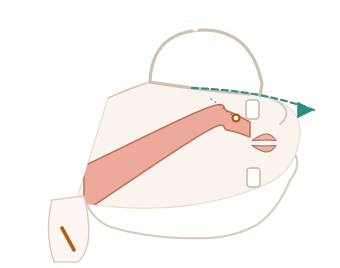
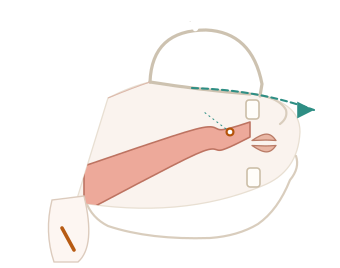
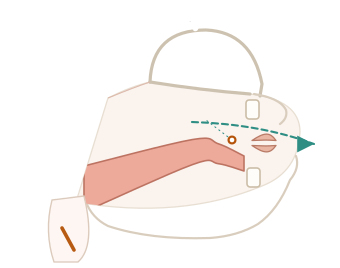
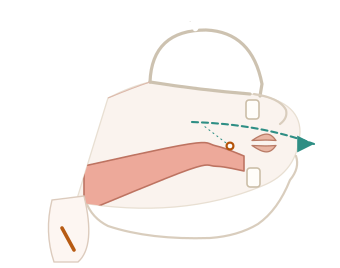
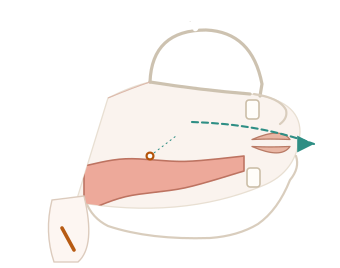
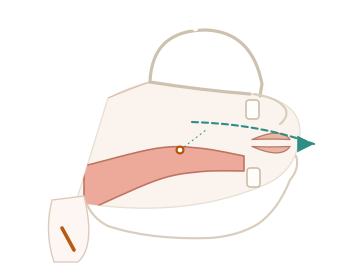
For /i/ the tongue is high and close to the hard palate, the muscle tense; for /ɪ/ it is clearly lower and more central, the muscle lax. Separate them by duration alone and /ɪ/ comes out as a vague /i/.
This is a matter of mouth position, not length — set the tongue right and the length follows.
A diphthong is not a long monophthong
/eɪ/ in late is two targets (start at /e/, glide to /ɪ/), not a stretched /ɛ/; /aɪ/ and /oʊ/ work the same way. Flattening a diphthong to a single vowel is the most audible error in this set.
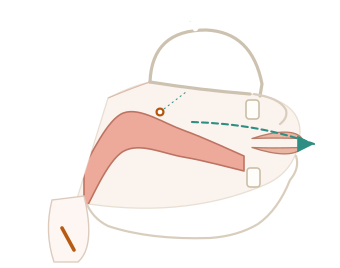
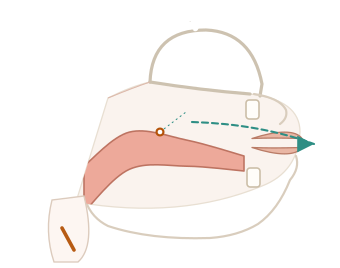
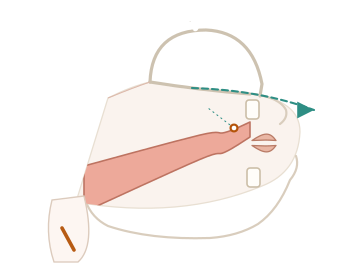
Articulation (side view)
One speaker, one instant: tongue position and lip shape only. The amber circle marks what to look at; the caption says how it differs from the sound it is usually confused with.
Spelling: no letter table here, because the letter table would be a lie
Five vowel letters cover roughly twenty vowel sounds, and one letter combination can be read three different ways. So this page gives four patterns that mostly hold — for everything else, use a dictionary.
One pair of letters, three sounds: /uː/, /ʊ/, /ʌ/. This is the least reliable corner of English spelling. It has to be learned word by word.
Fairly reliable, with real exceptions: bread /bred/, friend /frend/, great /greɪt/. Do not read every ea as /iː/.
One letter, four sounds: bad /æ/, cart /ɑː/, late /eɪ/, about /ə/. What decides it is history and syllable structure, not the spelling.
ship and sheep, pull and pool differ by a letter and by the entire vowel. The six pairs on this page were chosen for exactly that reason — hearing and memory are all you have.
Four places learners most often go wrong
Each one is audible in the clips on this page.
Pronouncing the short vowel as "a fast long one"
If your first language has no such tongue-height contrast, the natural move is "same sound, faster". But /ɪ/ sits much lower than /i/; shortening an /i/ produces a vowel that does not exist.
Self-check: play ship below and notice the tongue drops; it does not merely speed up.
Merging /i/ and /ɪ/ changes the word
This is not about sounding nice: once merged, the two words become one word to the listener. sheep and ship are a pair on this page — mishearing one replaces the meaning of the sentence.
Practice order: switch back and forth within a pair until you hear it; only then check the same vowels in other sentences.
Flattening diphthongs
The second target of /eɪ/ and /oʊ/ cannot be dropped. Drop it and late becomes let, coat becomes caught — this page puts both consequences side by side.
The sense of length in a diphthong comes from gliding, not from holding the first target. Glide fast rather than stall on the start.
/æ/ and /ɛ/ merged
The /æ/ of English is much lower with the jaw wider open; /ɛ/ sits higher. Merging them makes bad sound like bed.
Jaw check: /æ/ needs the jaw visibly lower, /ɛ/ only half open. A mirror is more reliable than listening to yourself.
Word list
27 words grouped by where the sound sits in the word. Click a word to hear it. These are recorded as separate words, not cut out of the sentences above — a word cut from a sentence carries its neighbours' transitions and always sounds muddier. All three groups use the same speaker, so what changes between them is position, not voice.
Word-initial9
Word-medial9
Word-final9
The word-final group only has i / u / eɪ / ɑ: ʊ, æ, ɛ and ʌ almost never end an English word (interjections like duh and meh aside). A position that has no examples gets no examples — padding it with a wrong one teaches the wrong thing.
Corpus and acoustic measurements
Click any word in a sentence to play from that word. The pale band over the waveform marks the measured boundary of the target word.
Per-token data
Every number below is measured directly from the audio, not hand-annotated.
| Token | Accent | Sex | Target | Word length | vowel duration | F0 | Pitch range | HNR |
|---|
Where the numbers come from
Every figure on this page can be recomputed from the notes below.
Corpus: 12 English sentences generated by a speech synthesis engine. Each minimal pair on this page is read by one and the same speaker — the difference is the point, and a change of speaker would inject timbre variation into it.
Word boundaries: taken from the engine's word-level WordBoundary events, with the constant offset between the engine timeline and the audio start corrected per utterance.
Phoneme boundaries: forced alignment with the MMS_FA acoustic model, mapping character-level timestamps onto the phoneme sequence by dynamic programming, at the model's frame is 20 ms and each boundary falls on a midpoint between character spans, so the effective resolution is about 10 ms. These are not durations allocated within the word by an experienced-weight table.
Pitch: computed frame by frame with Praat's autocorrelation (to_pitch), 10 ms frame shift, search range narrowed to the speaker's range estimated from the whole utterance, octave errors rejected.
What this page is: a view of how these sounds are distributed in the given corpus, not a pronunciation standard. Synthetic speech follows duration patterns close to human reading, but is not identical; the numbers will be recomputed once real recordings are wired in.
Transcription: this page uses an American style that leaves long vowels unmarked — sheep is written /ʃip/, the same sound textbooks write as /ʃiːp/, and pool as /pul/. The two conventions describe the same vowels; they differ only on whether length counts as a phoneme. The unmarked style is used here because the point this page argues is precisely that length is not what the contrast is made of: /ɪ/ and /i/ differ in tongue position and tension, and length follows. Most speakers in the corpus are American, and r-coloured vowels like /kɑrt/ do not take a British length mark anyway.