Unstressed r-coloured vowel · er / or / ar Identical tongue position to /ɝ/, but in an unstressed syllable: shorter and laxer (the -er of butter, teacher). It is extremely frequent in American English, and the usual error is to drop the curl entirely.
Three steps to /ɚ/
Tongue as for /ɝ/, volume halved.
Same tongue as /ɝ/
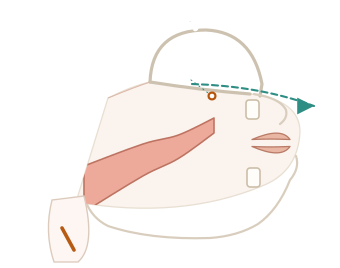
Tip curled toward the ridge without contact, tongue body hollowed. Put this drawing next to the /ɝ/ one: nearly identical — and that is correct, they are the same articulation.
Half the volume, short and lax
That is the whole difference: /ɚ/ is never stressed and is typically half as long. In butter the stress is on /bʌt/.
Self-check: water, teacher, brother
All three endings need an audible curl. If they sound like flat «wata», «teacha», the curl is gone.
Articulation (side view)
One speaker, one instant: tongue position and lip shape only. The amber circle marks what to look at; the caption says how it differs from the sound it is usually confused with.
Spelling: er, or, ar and ure all land here
The most frequent ending in English and the least rule-governed.
The commonest. Stressed it is /ɝ/ (person), unstressed /ɚ/ (teacher).
doctor /ˈdɑːktɚ/, color /ˈkʌlɚ/ — the same family as the stressed /ɝ/ in work.
dollar /ˈdɑːlɚ/, sugar /ˈʃʊɡɚ/. ★ Unlike the stressed /ɑr/ of car /kɑr/.
picture /ˈpɪktʃɚ/, nature /ˈneɪtʃɚ/. Here ʃ and ɚ merge, and learners often make two full beats of it.
Why learners replace /ɚ/
The L1 rhotic is rare; the American /ɚ/ is everywhere.
No curl at all
water becomes «wata», teacher «teacha», brother «brutha». The main error on this page and the most audible one.
The test: the ending must show a clear curl. Every clip here has voicing plus a tongue movement in that segment.
Over-stressed, read as /ɝ/
The -er is given full stress: water → /ˈwɔtɝː/, with the second syllable louder than the first.
Unstressed syllables must weaken in running speech.
Reduced to /ə/
The curl is so light it becomes /ə/: teacher → /ˈtiːtʃə/. That is correct in British RP — and a lost r in American English.
★ Depends on the accent you are learning: RP really has no curl. The corpus here is mostly American.
Word list
These 27 words are grouped by spelling source, not by position. ★ /ɚ/ occurs only in unstressed syllables and almost only word-finally, so the initial-position dimension is empty for it. All three groups use one speaker.
spelled er9
spelled or9
spelled ar / ure9
★ These three groups are split by spelling source (er / or / ar·ure), not by position. The reason is hard: /ɚ/ occurs only in unstressed syllables and almost only word-finally, so the initial-medial-final dimension is empty for it.
Corpus and acoustic measurements
Click any word in a sentence to play from that word. The pale band over the waveform marks the measured boundary of the target word.
Per-token data
Every number below is measured directly from the audio, not hand-annotated.
| Token | Accent | Sex | Target | Word length | ɚ duration | F0 | Pitch range | HNR |
|---|
Where the numbers come from
Every figure on this page can be recomputed from the description below.
Corpus: 12 English sentences synthesised with four American voices (two male, two female), each containing one target word, covering initial, medial and final positions. Audio is 22.05 kHz mono 64 kbps; each clip runs from 1.2 s before to 1.5 s after the target word.
Word boundaries: taken from the engine's word-level timestamps (WordBoundary) and corrected for the fixed offset between the engine timeline and the audio start (estimated per item). The target word is shaded in the waveform.
Phoneme boundaries: measured by forced alignment with the MMS_FA acoustic model. Each character's aligned frame range is kept, then a dynamic program maps the character sequence onto the phoneme sequence (th→θ, ng→ŋ, ck→k). Boundaries fall in the middle of the transition between characters; within-word coverage is 100%. Time precision is the model frame length, 20 ms, and boundaries are taken at midpoints, so effective resolution is about 10 ms.
Pitch: Praat's autocorrelation (to_pitch), 10 ms frame step, search range narrowed to the speaker's estimated range, octave errors removed. «Pitch range» is max minus min F0 within the word.
Why there are no paired differences here: this is a single-phoneme page. Eight other pages are contrast pages (θ/ð, l/r/n, vowel length) where the numbers come from paired words read by one speaker. A single-phoneme page has nothing to compare against — pairing it with a neighbour would measure that neighbour, which belongs to a different page.