Voiced bilabial nasal · m Both lips close, the velum lowers, and the sound leaves through the nose. The lip shape is identical to /b/ — the lowered velum is the whole difference, and it is exactly what turns come into cub.
Three steps to /m/
Close the lips first, then redirect the airstream through the nose.
Close both lips
Press the lips together as for /b/. In a mirror there should be no gap — a gap gives you /w/ or /v/, not /m/.
Lower the velum
This is the whole secret of /m/: keep the lips closed while lowering the soft palate so the air escapes through the nose. The blue dashes in the drawing trace that route.
Self-check: pinch your nose
Sustain an m and pinch your nose — the sound should stop at once. If nothing changes, the air is not going through the nose and you are producing a closed /b/. This tests the airstream path, not your hearing, which makes it more reliable than listening back.
Articulation (side view)
One speaker, one instant: tongue position and lip shape only. The amber circle marks what to look at; the caption says how it differs from the sound it is usually confused with.
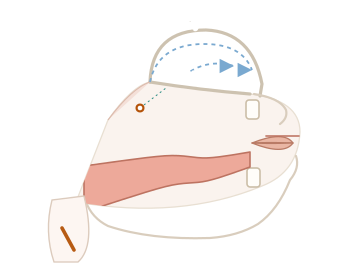
Spelling: m is stable — the silent neighbours are the trap
The letter m almost always means /m/. What goes wrong is the unpronounced b or n next to it.
Initial, medial and final m all spell the same sound.
Final mb is /m/ only. climb is /klaɪm/. Pronouncing the b is a spelling error, not a hearing error.
Final mn is /m/ only: autumn is /ˈɔːtəm/.
Double m is a single /m/. What changes is the length of the preceding vowel, not the number of m's.
Why learners replace /m/
The nasal itself is easy; what fails is the final position and the closure.
Dropping the final /m/
Many languages allow no m-coda, so time becomes /taɪ/ and home becomes /ho/. The consonant does not get quieter — it never appears.
The nine final words on this page exist precisely for this position: compare how long the source speaker holds the m.
Substituting /n/
If n is a legal coda in your language, the brain picks the nearest available nasal: come → /kʌn/, team → /tiːn/.
Both are nasals, so pinching the nose blocks both. The difference is visible: /m/ ends with closed lips, /n/ with the tongue on the ridge and the lips slightly apart.
Incomplete lip closure
The lips approach without touching, producing a nasalised vowel that is neither m nor a vowel.
Only a mirror settles this: no gap may be visible during /m/.
Squeezed out in unstressed syllables
In words like summer the m sits in an unstressed syllable and gets flattened away entirely.
This belongs to reduction, covered in the connected-speech section; this page deals with the phoneme itself.
Word list
27 words grouped by where the sound sits in the word. Click a word to hear it. These are recorded as separate words, not cut out of the sentences above — a word cut from a sentence carries its neighbours' transitions and always sounds muddier. All three groups use the same speaker, so what changes between them is position, not voice.
Word-initial9
Word-medial9
Word-final9
Three groups of nine; the final group is entirely words ending in /m/ (time, room, home, team…). Final /m/ is extremely common in English, so start with that group.
Corpus and acoustic measurements
Click any word in a sentence to play from that word. The pale band over the waveform marks the measured boundary of the target word.
Per-token data
Every number below is measured directly from the audio, not hand-annotated.
| Token | Accent | Sex | Target | Word length | m duration | F0 | Pitch range | HNR |
|---|
Where the numbers come from
Every figure on this page can be recomputed from the description below.
Corpus: 12 English sentences synthesised with four American voices (two male, two female), each containing one target word, covering /m/ initially, medially and finally. Audio is 22.05 kHz mono 64 kbps; each clip runs from 1.2 s before to 1.5 s after the target word.
Word boundaries: taken from the engine's word-level timestamps (WordBoundary) and corrected for the fixed offset between the engine timeline and the audio start (estimated per item). The target word is shaded in the waveform.
Phoneme boundaries: measured by forced alignment with the MMS_FA acoustic model. Each character's aligned frame range is kept, then a dynamic program maps the character sequence onto the phoneme sequence (th→θ, ng→ŋ, ck→k). Boundaries fall in the middle of the transition between characters; within-word coverage is 100%. Time precision is the model frame length, 20 ms, and boundaries are taken at midpoints, so effective resolution is about 10 ms.
Pitch: Praat's autocorrelation (to_pitch), 10 ms frame step, search range narrowed to the speaker's estimated range, octave errors removed. «Pitch range» is max minus min F0 within the word.
Why there are no paired differences here: /m/ is a single-phoneme page. Eight other pages are contrast pages (θ/ð, l/r/n, vowel length) where the numbers come from paired words read by one speaker. A single-phoneme page has nothing to compare against — pairing man with ban would measure /m/ against /b/, which belongs to a different page.